 Click to enlarge
Geometry: Shape, Space & Angles
Perimeter, area, angles, coordinates and nets, with the diagrams children actually meet in the exam.
- A rules page before every topic, written so a parent can teach from it
- 25 multiple-choice questions per topic, graded from accessible to scholarship level
- Full answer key
- Covers the whole 11+ syllabus across Books 1–6, then applies it in Books 7–12
Want the whole series? The full Maths series is £247, under £21 a book.
How this book is used in our course
Each topic opens with a rules page. A parent reads it with the child, then the child attempts the 25 questions unaided. Mark them, log the score, and work through every wrong answer with the key. Anything under 90% is repeated after a fortnight. The topic is only finished when the cold repeat clears 90%.
Where it sits in the series
- Previous book in the series: Book 3, Percentages, Ratios, Proportions & Probability
- Next book in the series: Book 5, Statistics & Data Handling
What's inside Maths Mastery 4
Five real pages from the book, so you can see exactly what your child will work from. All 9 sample pages are in the viewer.
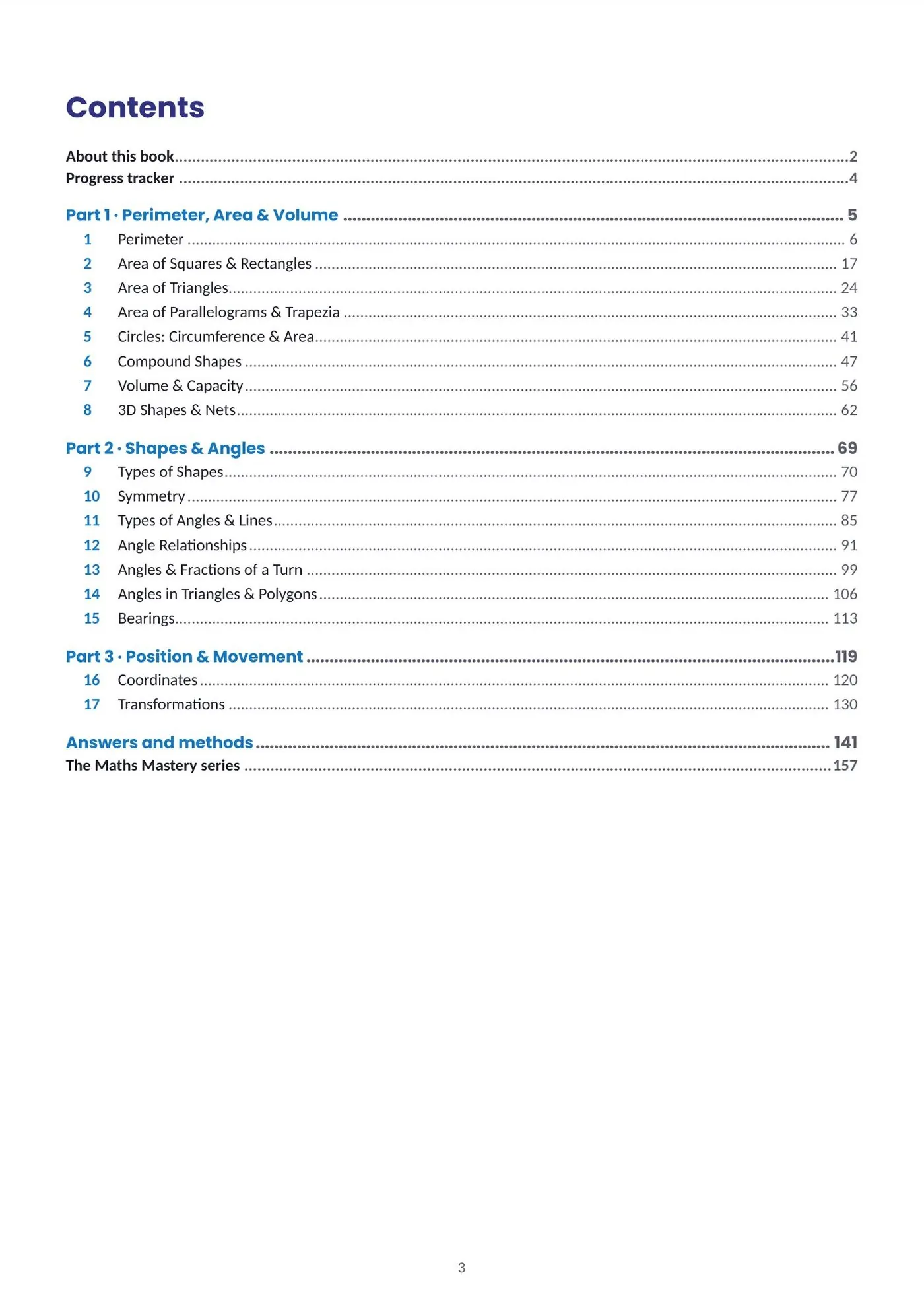
Seventeen topics in three parts: every shape, angle and movement the papers draw.
Part 1 is perimeter, area and volume, from rectangles to circles, compound shapes and nets. Part 2 is shapes and angles: types of shape, symmetry, angle relationships, angles in triangles and polygons, and bearings. Part 3 is position and movement: coordinates and transformations. These are the diagram questions that cost marks because a child has seen the shape but never the method.
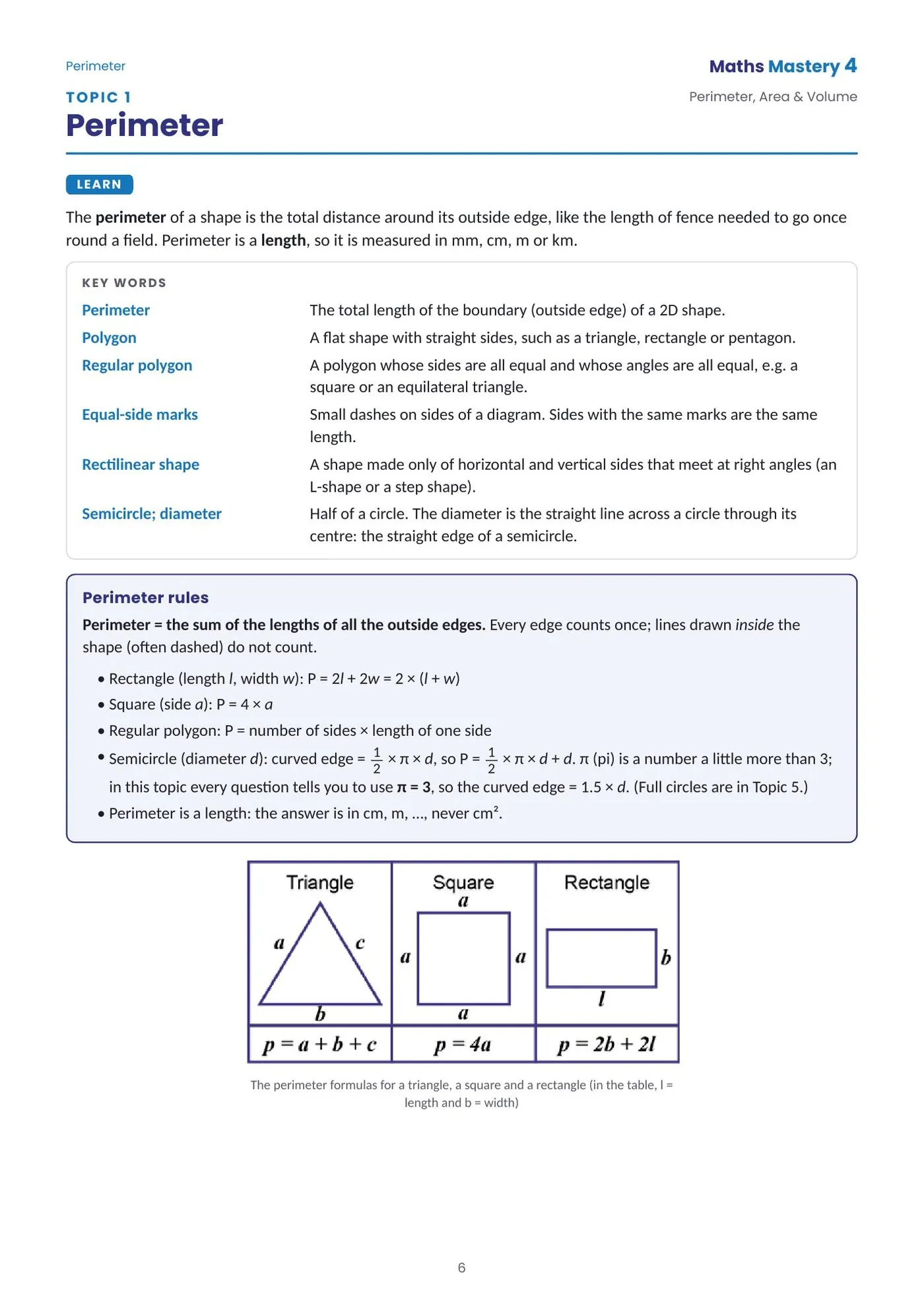
Perimeter is a length. Lines drawn inside the shape do not count.
Six key words, including the ones exam diagrams rely on: equal-side marks and rectilinear shapes. The rules box gives the formulas for rectangles, squares, regular polygons and semicircles, and says plainly which value of π each question will tell you to use. The last rule is the one that loses marks: perimeter is in cm, never cm².
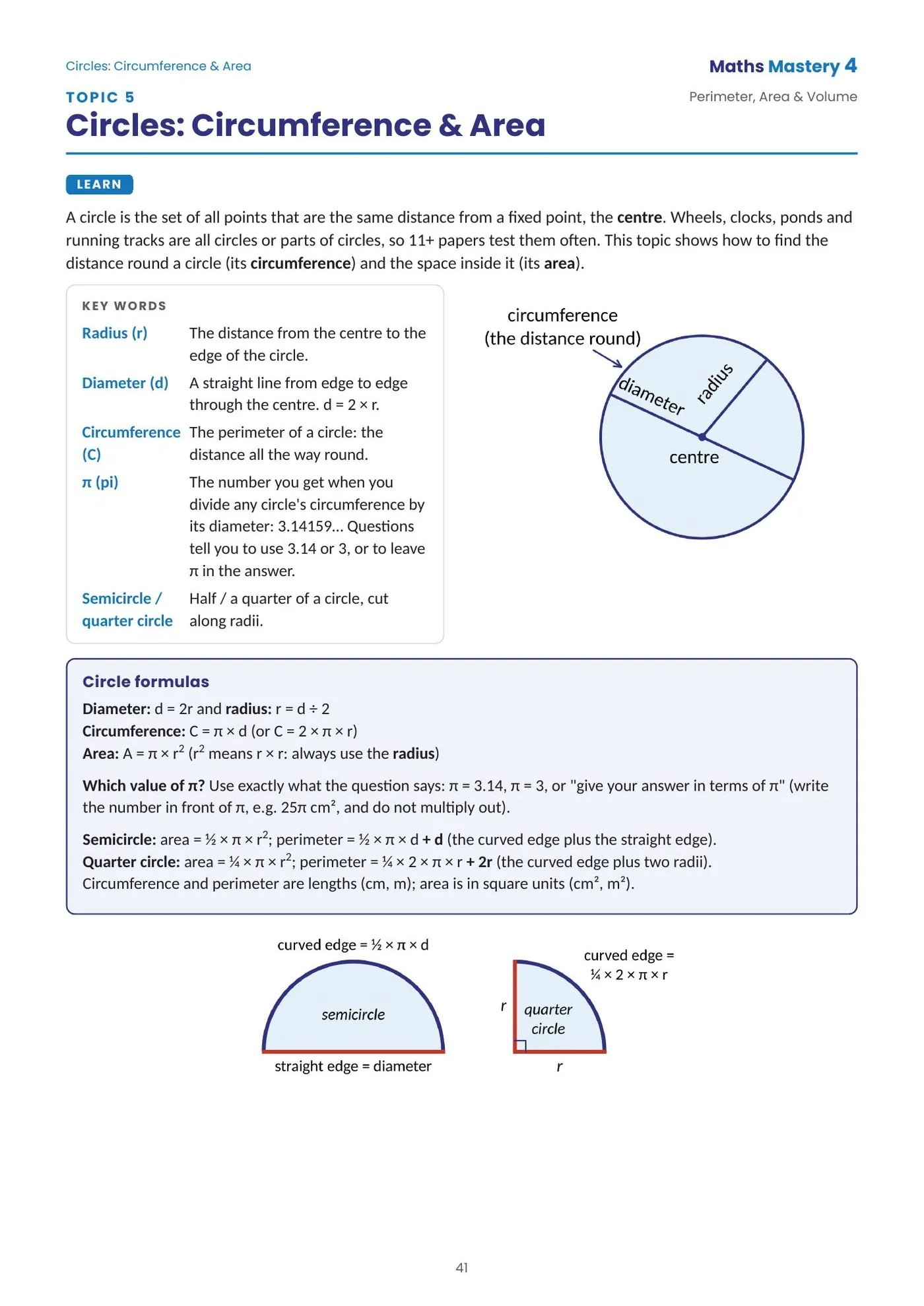
Circumference, area, and the question of which π to use.
Radius, diameter, circumference and π defined, with a labelled diagram. The formulas box insists on using exactly the π the question gives, 3.14, 3, or leaving the answer in terms of π, and warns that area always uses the radius. Semicircles and quarter circles are drawn with their straight edges marked, because the perimeter of a semicircle includes the diameter and the exam knows most children forget it.
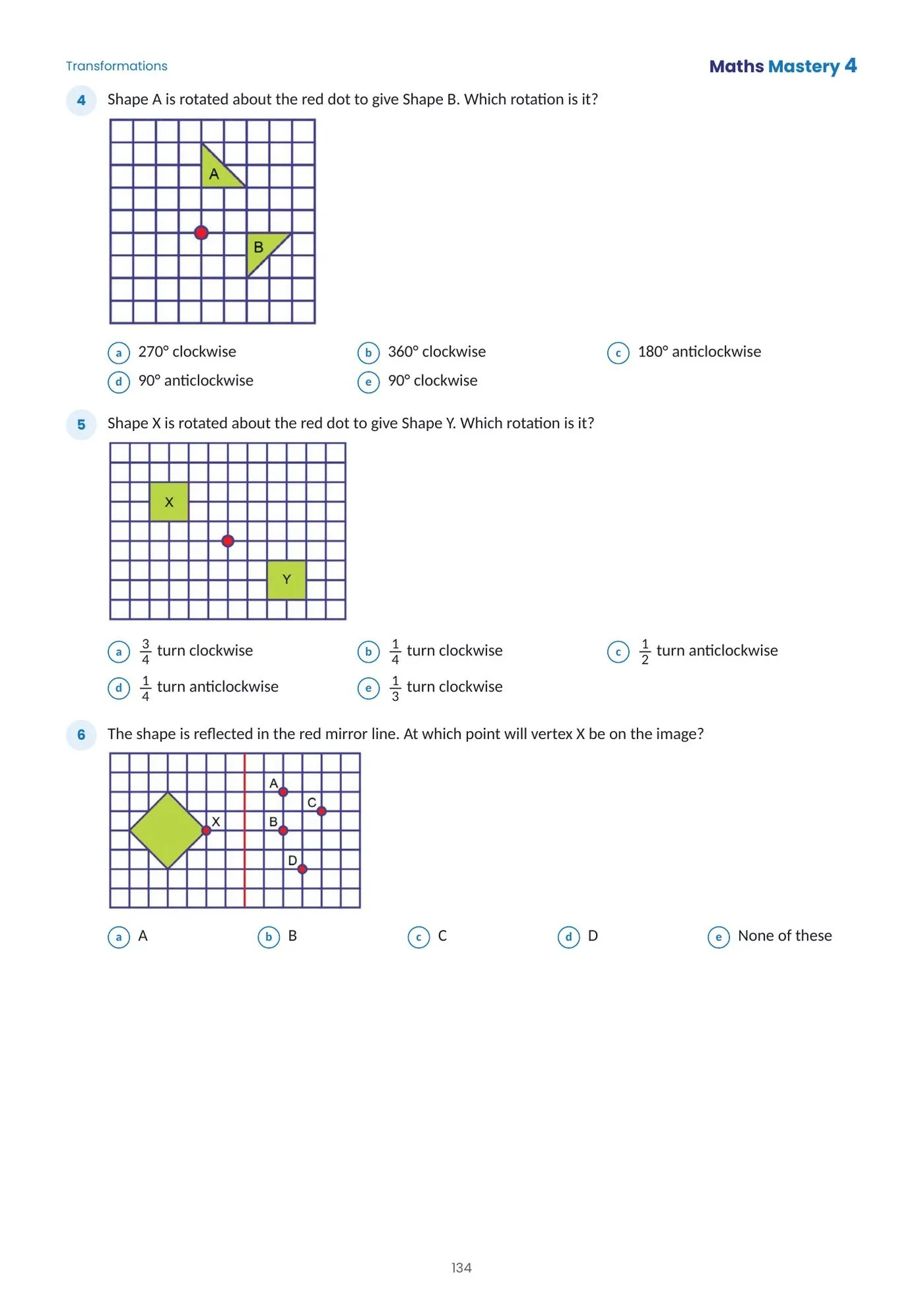
Rotation about a point, reflection in a mirror line: done on a grid, the way the exam draws it.
Question 4 rotates a triangle about a red dot and asks which rotation it was, with 90° clockwise and 90° anticlockwise both on offer. Question 5 asks the same in fractions of a turn. Question 6 reflects a shape and asks where one vertex lands. These are multiple-choice, timed-paper questions, and the distractors are the mistakes children make.
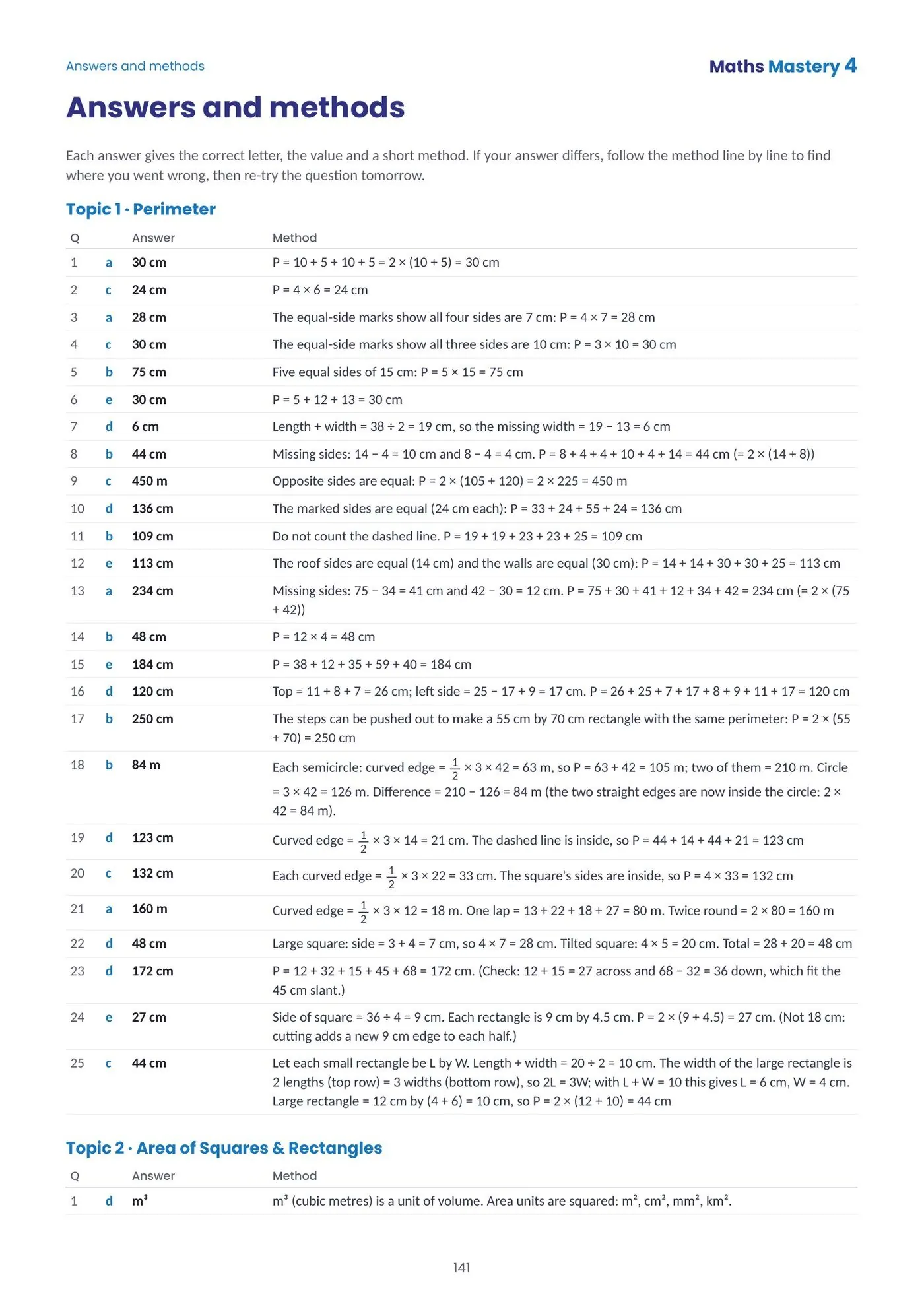
Every answer, every method, fully worked.
Question 11: "Do not count the dashed line." Question 18, the running track: the curved edges found first, then the two straight edges that are now inside the circle. Question 24 explains the wrong answer too: "Not 18 cm: cutting adds a new 9 cm edge to each half." A tutor’s explanation for every one of the 25 questions in every topic, so the parent never has to work it out at the kitchen table.
All 17 topics in the book follow the pattern shown here.
Other Year 4 books in Maths Mastery

Number Relationships & Decimals
Place value, number bonds, factors, multiples and decimals: the ground every later topic stands on.

Fractions, Measures, Money & Time
The four topics that account for most lost marks in Year 4 maths, taught as one connected system.

Percentages, Ratios, Proportions & Probability
Proportional reasoning, the single skill that separates top-set maths from the rest.

Mental Maths Foundations
The Year 4 mental maths book. Speed and accuracy without a pen.