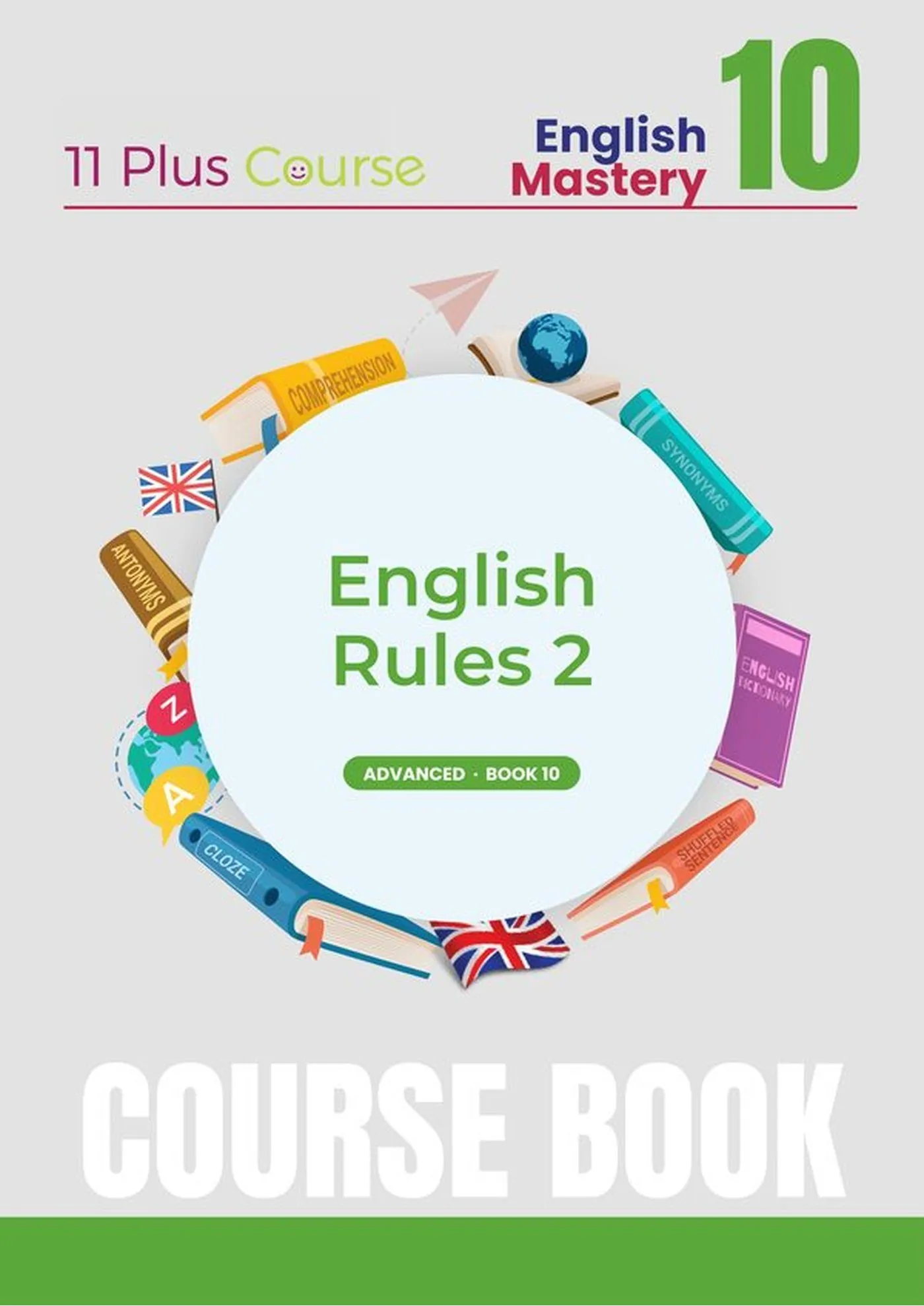
 Click to enlarge
English Rules 2
The harder grammar: clauses, tenses, apostrophes and the rules examiners test deliberately.
- 24 rules in the book
- Each rule taught one at a time, with examples a child can copy
- Full answer key, independently re-checked question by question
Want the whole series? The full English series is £497, under £19 a book.
How this book is used in our course
English books are worked in short daily sessions rather than one long sitting. For vocabulary, the child covers the meaning, says it aloud, then checks; words that are missed go on a card for the week. For comprehension and cloze, the child attempts the passage under a loose time, then marks against the key and rewrites any answer that lost marks.
Where it sits in the series
- Previous book in the series: Book 9, Vocabulary 2 Testbook
- Next book in the series: Book 11, English Rules 2 Testbook
What's inside English Mastery 10
Three real pages from the book, so you can see exactly what your child will work from. All 8 sample pages are in the viewer.
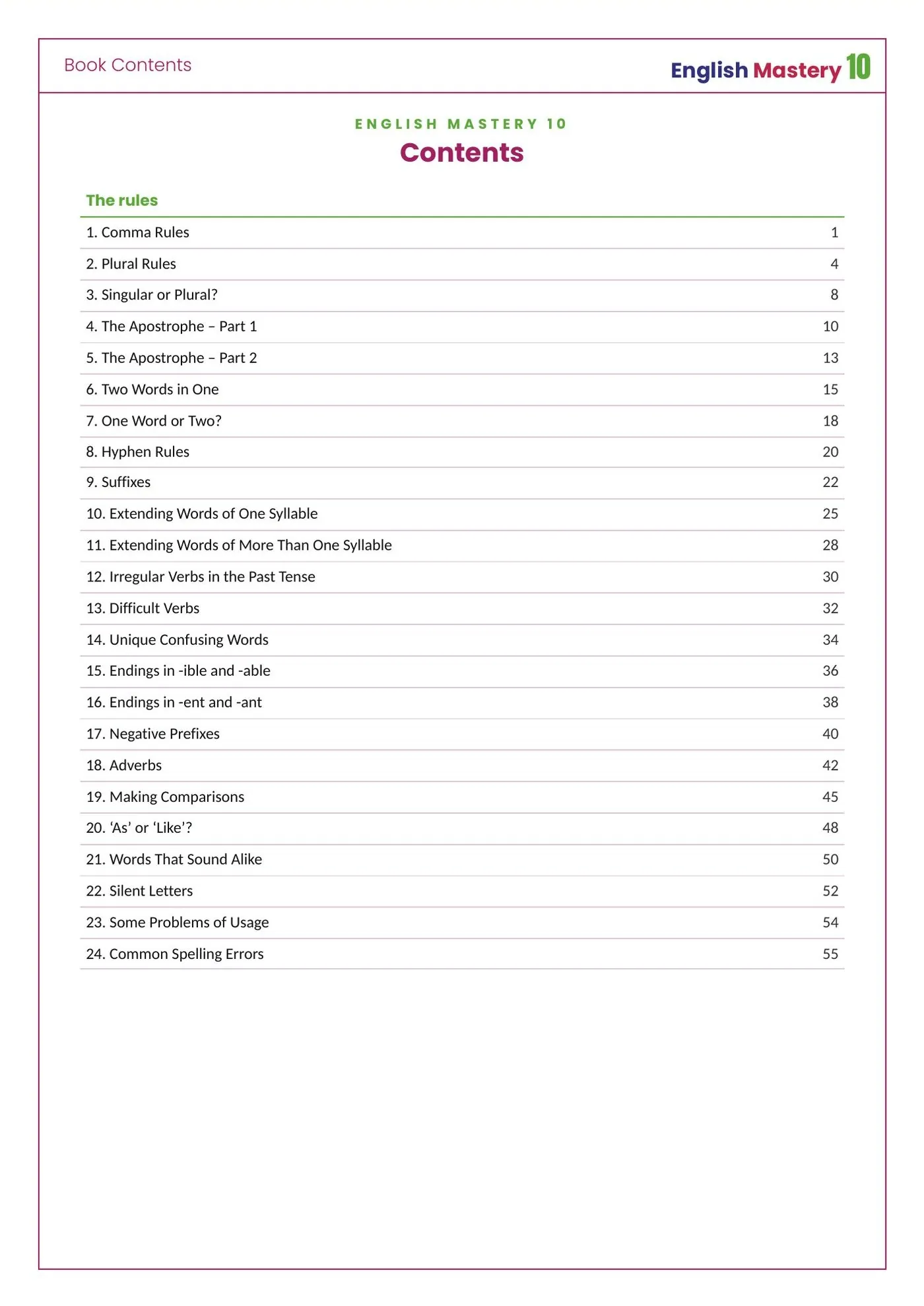
Twenty-four rules, harder than Rules 1: the ones examiners test deliberately.
Commas, plurals and apostrophes return at a higher level, then the rules Year 5 writing is marked on: two words in one, one word or two, hyphens, suffixes, extending words of one and more than one syllable, -ible and -able, -ent and -ant, negative prefixes, as or like, and the problems of usage and common spelling errors that cost marks in creative writing. Fifty-six pages, every rule boxed, every rule with a table of examples.
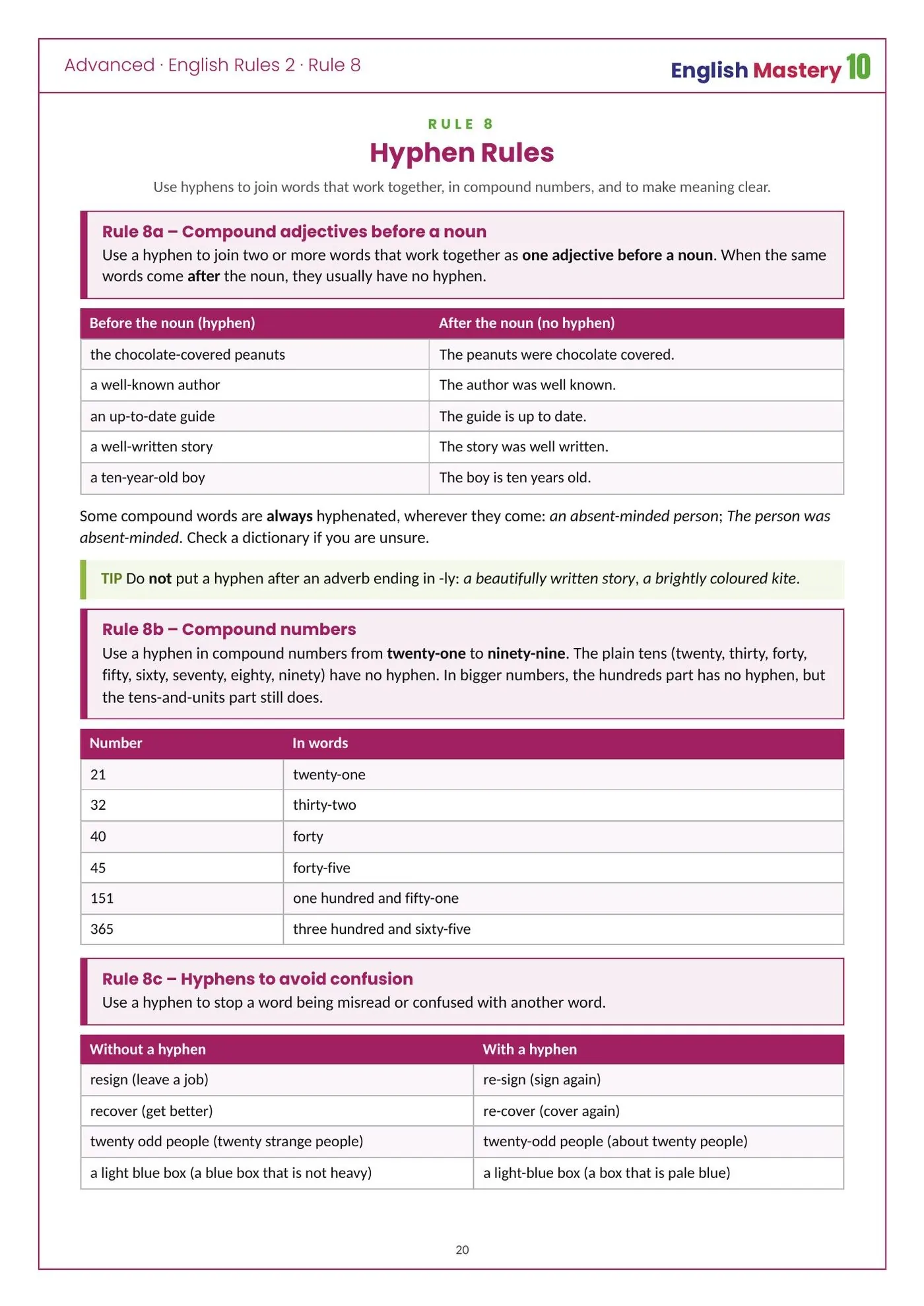
A well-known author, an author who was well known: the hyphen rule nobody teaches, in a table.
Rule 8a: compound adjectives before a noun take a hyphen, after the noun they do not, with the tip that an -ly adverb never takes one. Rule 8b: twenty-one to ninety-nine are hyphenated, forty is not, and one hundred and fifty-one still is. Rule 8c: hyphens to avoid confusion, resign and re-sign, recover and re-cover, twenty odd people and twenty-odd people. A child who writes "a ten year old boy" in a creative writing piece loses a mark; this page is why they will not.
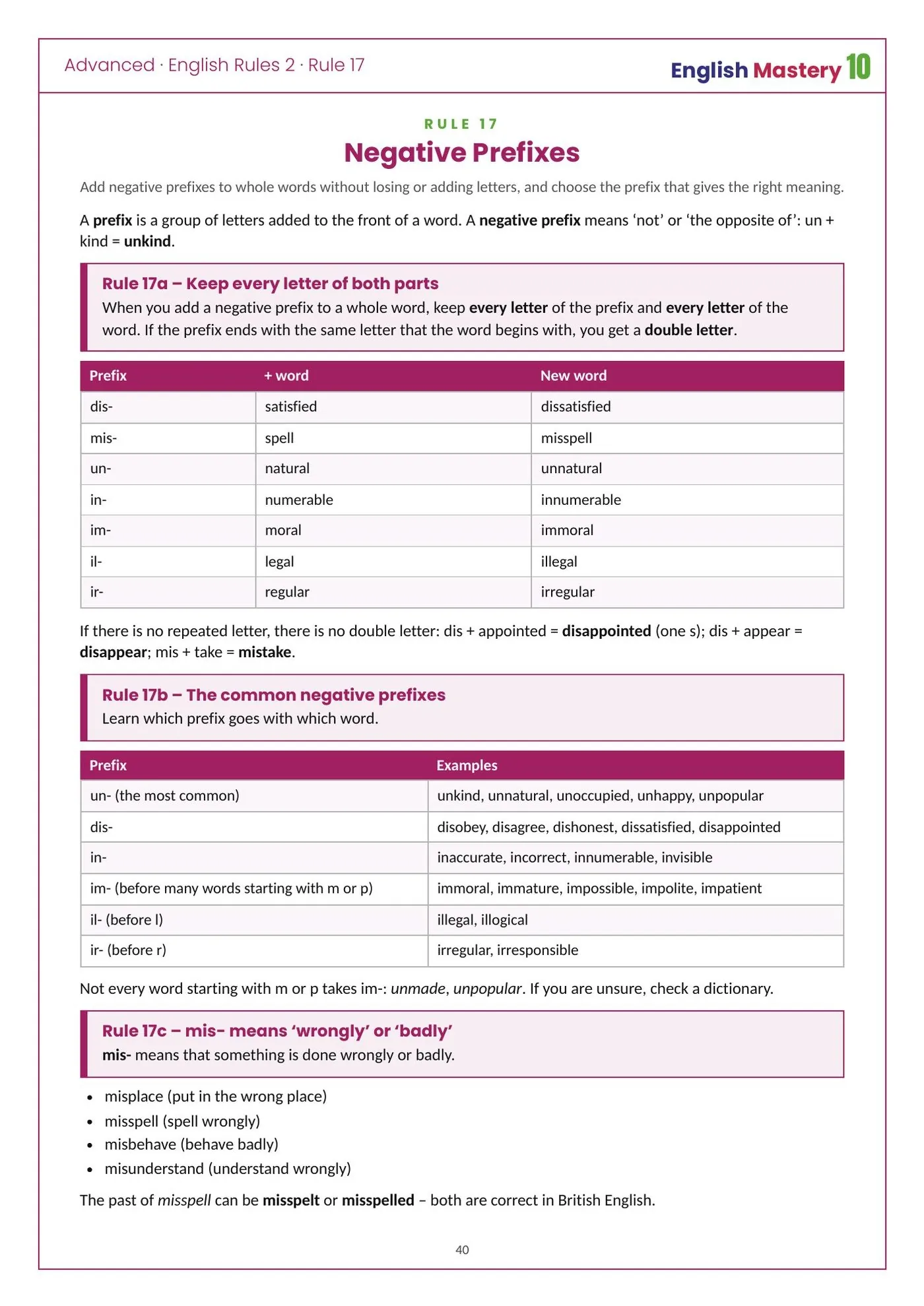
Dissatisfied has two s’s, disappointed has one, and the rule tells a child why.
Rule 17a: keep every letter of both parts, so dis + satisfied gives a double s and dis + appointed does not. Rule 17b: which prefix goes with which word, un-, dis-, in-, im- before m and p, il- before l, ir- before r. Rule 17c: mis- means wrongly or badly. These are the spelling questions GL papers set as multiple choice, and the rule turns a guess into a certainty.
All 24 rules in the book follow the pattern shown here.
Other Year 4 books in English Mastery

Vocabulary 1
The first word list: each word with a child-friendly meaning, synonyms, antonyms and a sentence.

Vocabulary 1 Testbook
Tests every word in Vocabulary 1 the way the exam does.

English Rules 1
Grammar and punctuation rules taught one at a time, with examples a child can copy.

Vocabulary 2
992 words in 25 alphabetical sets, with meanings, synonyms, antonyms and sentences.