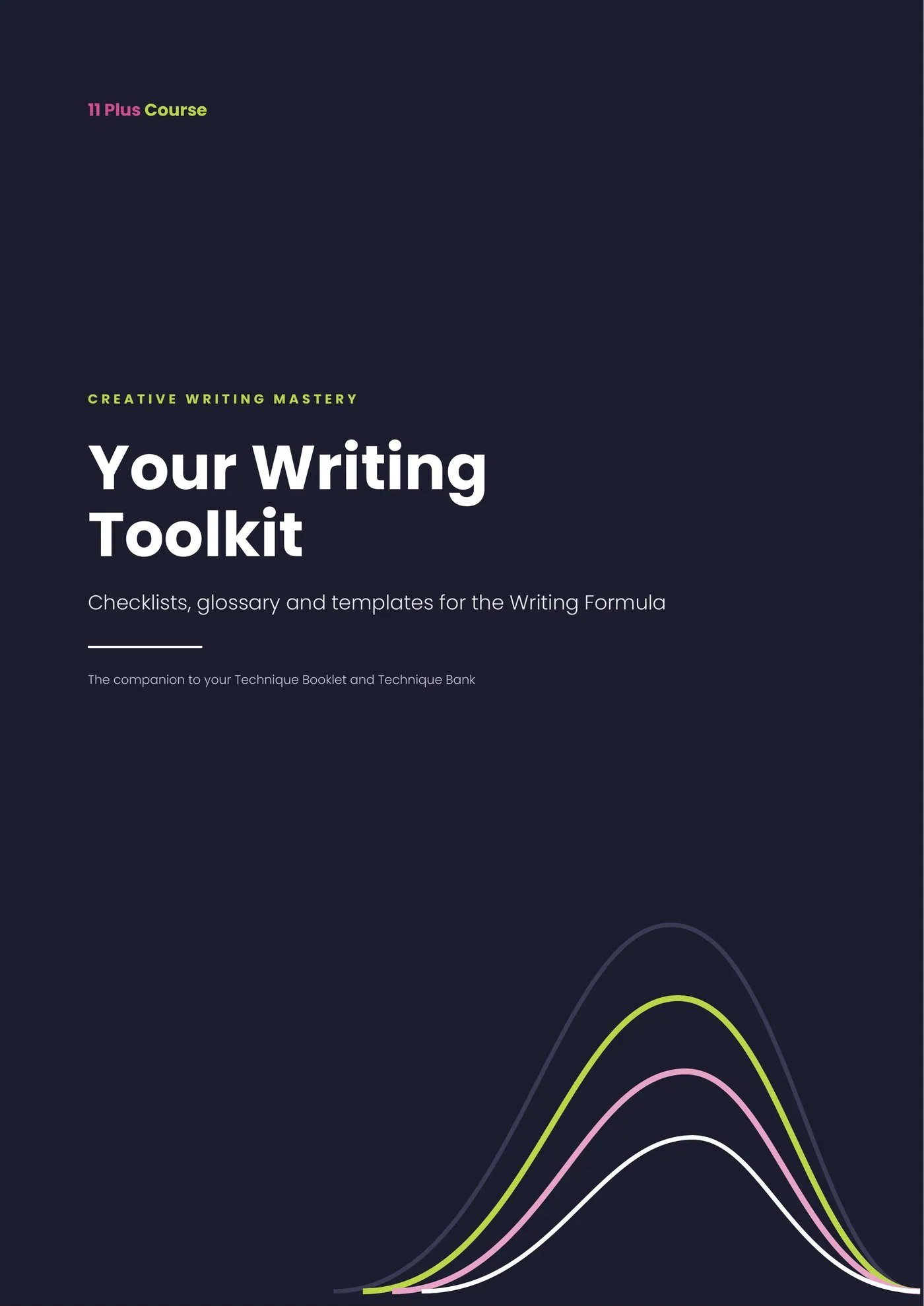
 Click to enlarge
Your Writing Toolkit
Every checklist, every mistake to avoid, the glossary and seven templates, open beside every piece of writing.
- Every checklist from the Technique Booklet in one place
- Mistakes to avoid, each pointing to the section that fixes it
- A glossary of every term, A to Z
- Seven templates, from the quick plan sheet to the drill log
Want the whole series? The full Creative Writing series is £129, under £17 a book.
How this book is used in our course
Keep the Toolkit open beside every piece of writing. Plan on the quick plan sheet, write, then tick the checklists. When a mistake from the list appears, go straight to the Technique Booklet section it points to, and log it on the My Common Mistakes page so it is not made twice.
Where it sits in the series
- Previous book in the series: Book 1, The Technique Booklet
- Next book in the series: Book 3, Settings & Characters
What's inside Creative Writing Mastery 2
Four real pages from the book, so you can see exactly what your child will work from. All 7 sample pages are in the viewer.
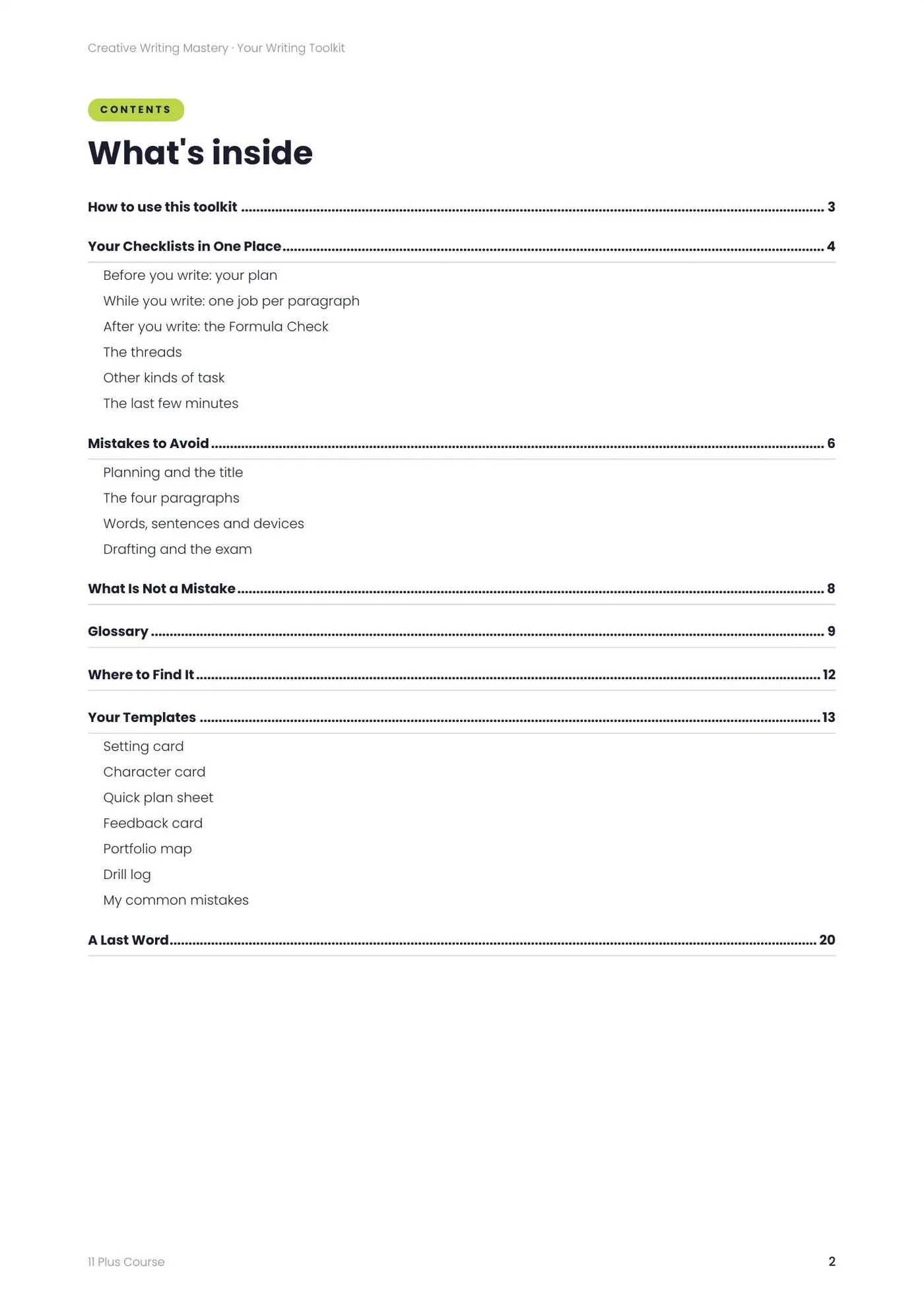
The companion to the Technique Booklet: everything a child needs at the desk, in twenty pages.
Every checklist in one place, the mistakes to avoid, what is not a mistake, the glossary, a where-to-find-it index, and seven templates: setting card, character card, quick plan sheet, feedback card, portfolio map, drill log and my common mistakes. The Technique Booklet teaches the method; the Toolkit sits open beside every piece of writing.
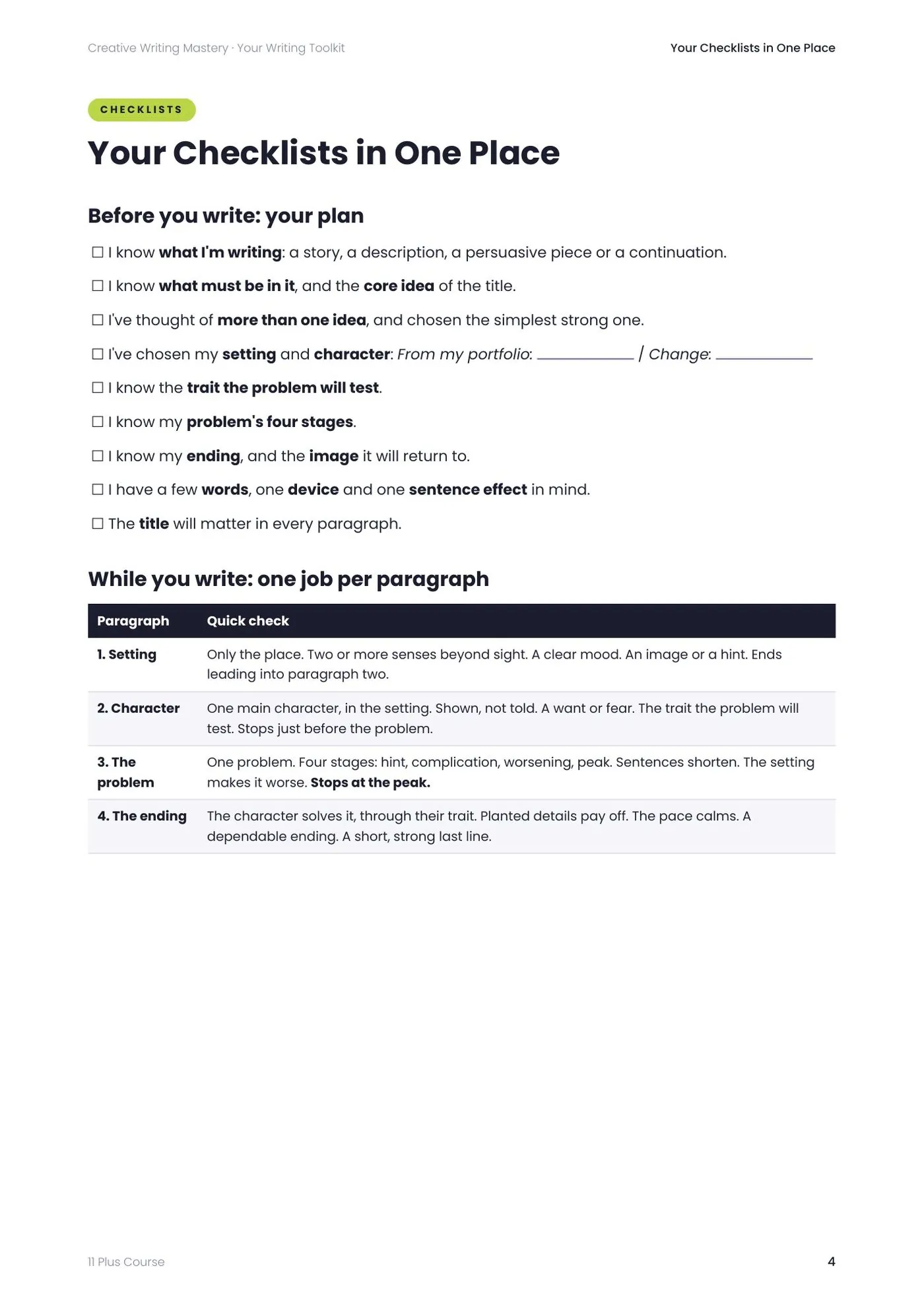
Before you write, while you write, after you write.
Before: do I know the task, the core idea of the title, my setting and character, the trait the problem will test, the problem's four stages and my ending? While: one job per paragraph. After: the Formula Check. Plus the threads, the other kinds of task and the last few minutes of the exam. A child ticks the boxes, and the piece stops depending on how they felt that morning.
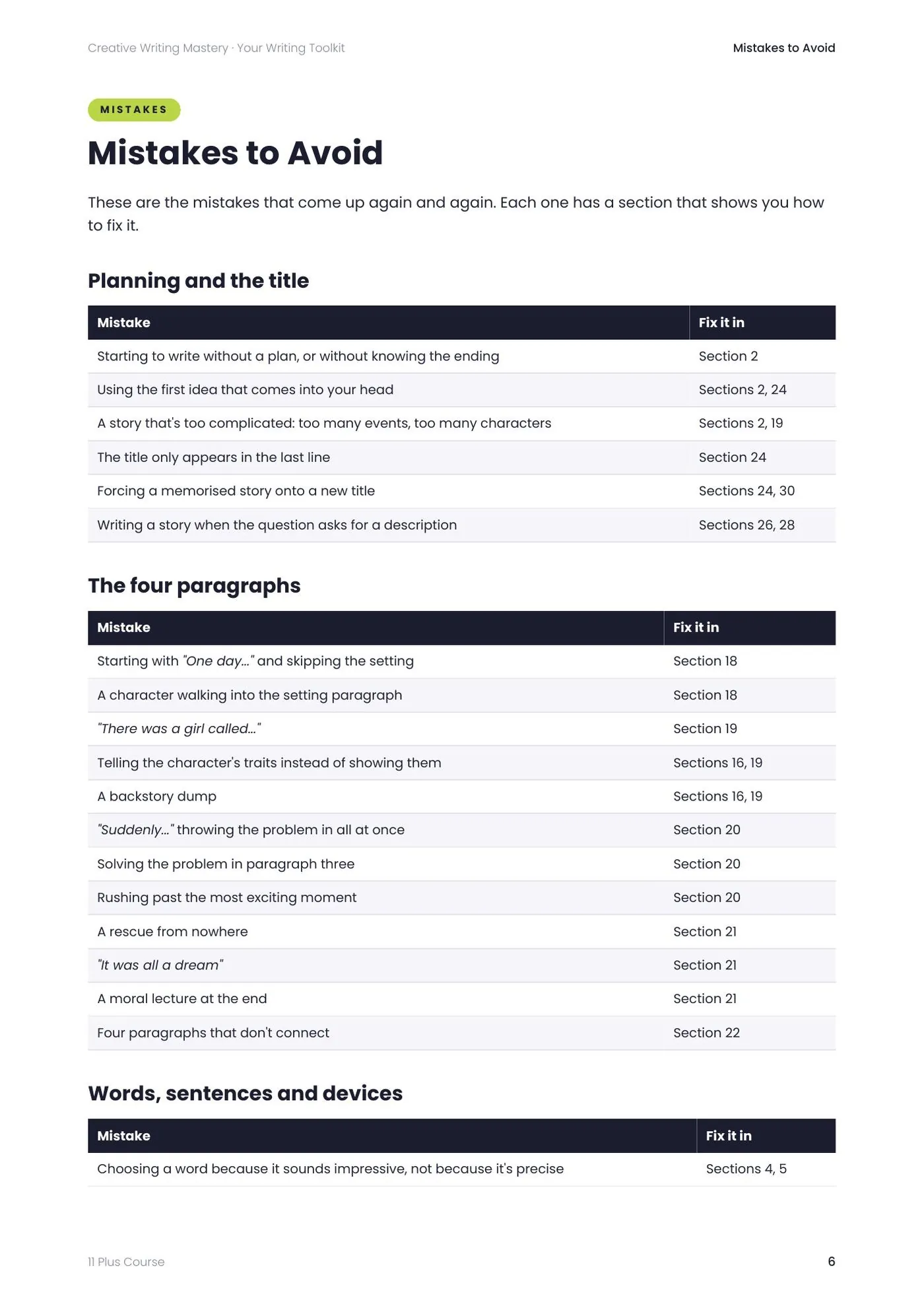
Every mistake that comes up again and again, with the section that fixes it.
"One day…" and skipping the setting. "There was a girl called…". A backstory dump. "Suddenly…" throwing the problem in all at once. Solving it in paragraph three. A rescue from nowhere. "It was all a dream." A moral lecture at the end. Each mistake points straight to the Technique Booklet section that fixes it, so marking a piece turns into a reading list.
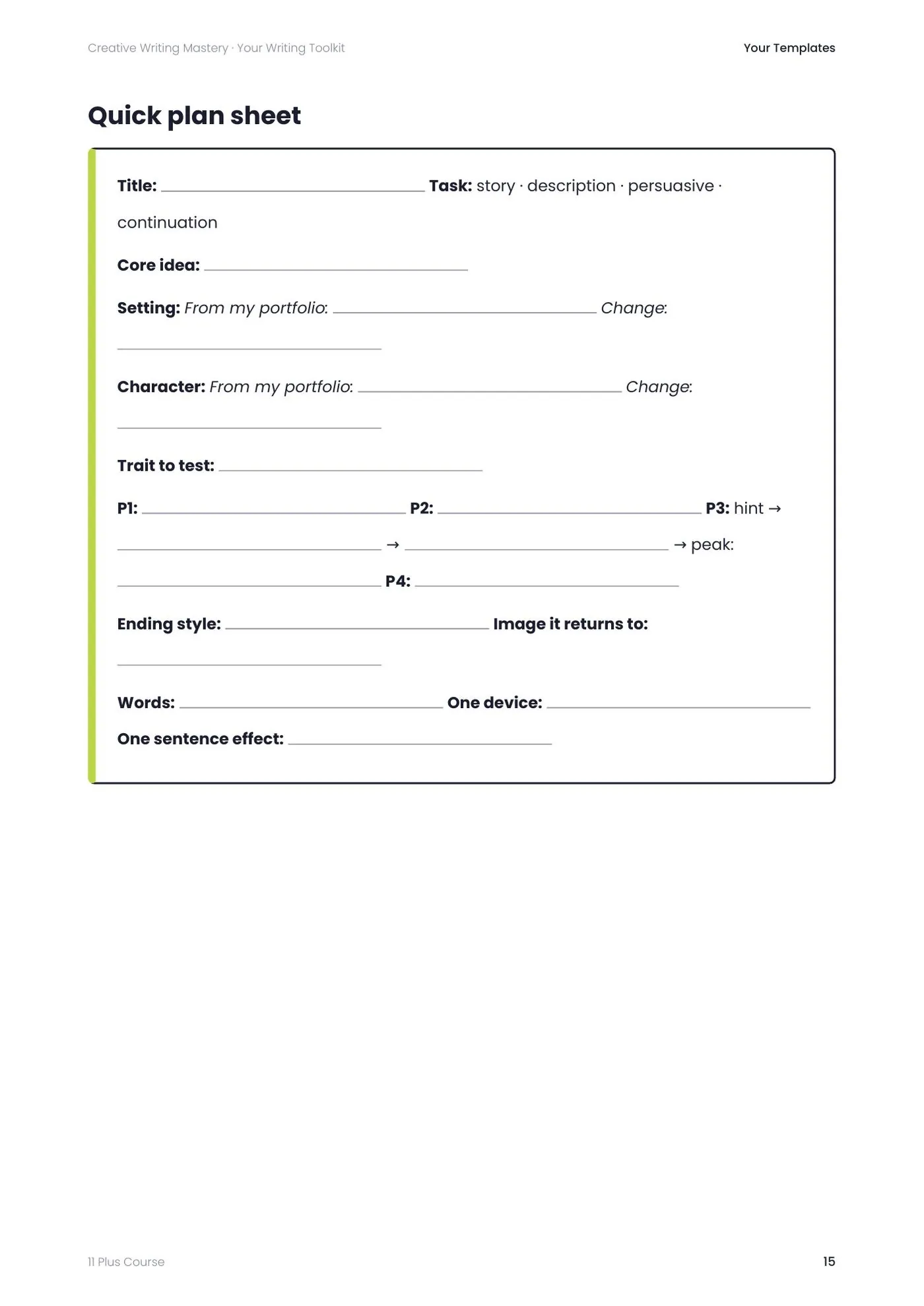
The five-minute plan as a sheet a child can fill in under exam conditions.
Title, task, core idea, setting and character from the portfolio and what to change, the trait to test, the four paragraphs with the problem climbing from hint to peak, the ending style, the image it returns to, one device and one sentence effect. Fill it in for every practice title until the plan happens in the head.
All 7 templates in the book follow the pattern shown here.
Other Year 4 & 5 books in Creative Writing Mastery

The Technique Booklet
The complete Writing Formula in more than 380 pages: plan in five minutes, write four paragraphs, check your own work, then every other kind of task.

Settings & Characters
The scholarship groundwork: five annotated model settings, two bonus settings and five model characters, each with the blueprint behind it.

Settings & Characters: Model Descriptions
Ten short model paragraphs to read, learn and adapt: five settings and five characters.

6-Minute Drills
Every setting and character written against the clock, marked out of 10, then redrafted to scholarship standard.